Generate Parsers! Prevent Exploits!
Or
LangSec for Ruby Devs
Or
Hey!
Theory of Computation
is relevant to Web Development
(maybe)
What?
exploits!
formal languages!
generating parsers!

source

source

source
Exploits! They Suck!
Having an app exploited sucks
Attackers find
Chink in armor
hole in the wall
crack in the dam
analogy in analogy
Achilles Heel
Attackers get
crown jewels
DB, eval
shell
ROOT!!
the whole kit n' caboodle
PSA:
Your passwords are hashed and salted, Right?
Exploits ~~ Tricks
Hard to predict
Unrelated
Buffer Overflow
SQL Injection
XSS
…
∞
all different?
No ! ! !
Exploits are all the same!
Unexpected Computation!
Computation!
Theory of Computation: Hand Wave Edition

*NOT YET*
Exploit != Trick
Exploit == Machine
How does an exploit work?
- Takes Input
- ??? (Does Stuff)
-
Output
/
profit
(profit is important w/ exploits)
Same as regular program
What's different?
Exploit anatomy
undefined behavior in your app
communication channels
Exploits live
inside
your app / framework
Input Via Host Application's Inputs
Exploit === Weird Machine *
* technical term
App |
    | <- IN
    |
(past app code)
App Code |
     /---| <- IN
     |   |
     v   |
(to exploit)
     |     |
     v     |
  Exploit  |
stopping exploits
jam their comms!
validate inputs before use
IN - what is it?
App |
    | <- IN
    |
IN:
instructions to the exploit
Exploit == Weird Machine
IN:
program in exploit-ese
asm_sql_injection anyone?
Example:
Rails XML(type=yaml)
CVE-2013-0156
(not actual program)
1 2 3 4 | <yaml type="yaml"> ---- !ruby/object:Evil hi: eval_me </yaml> |
...
Running Ruby!
:-(

PSA:
Everybody's patched, right?
What's the real problem here?
Bad Input validation!
What's the fix
Good Input Validation!
No Bad input allowed!
But How?
recognize inputs completely before processing them
LangSec
Language Theoretic Security
recognize inputs completely before processing them
source
recognize inputs completely before processing them
Recognize?
Are you talking about decidability?
yep
Theory of Computation: Hand Wave Edition
Chapter 0: Decidability
In a formal system, do all statements in that system have a yes or no answer?
an example
"This statement is false."
halting problem
undecidable
/handwave
Undecidable problems exist
what about input validation?
:-(
for certain types of input, recognizing is undecidable
being sure an input won't trigger exploit:
impossible

"certain types"
Theory of Computation: Hand Wave Edition
Chapter 1: Formal Languages
Chomsky Hierarchy
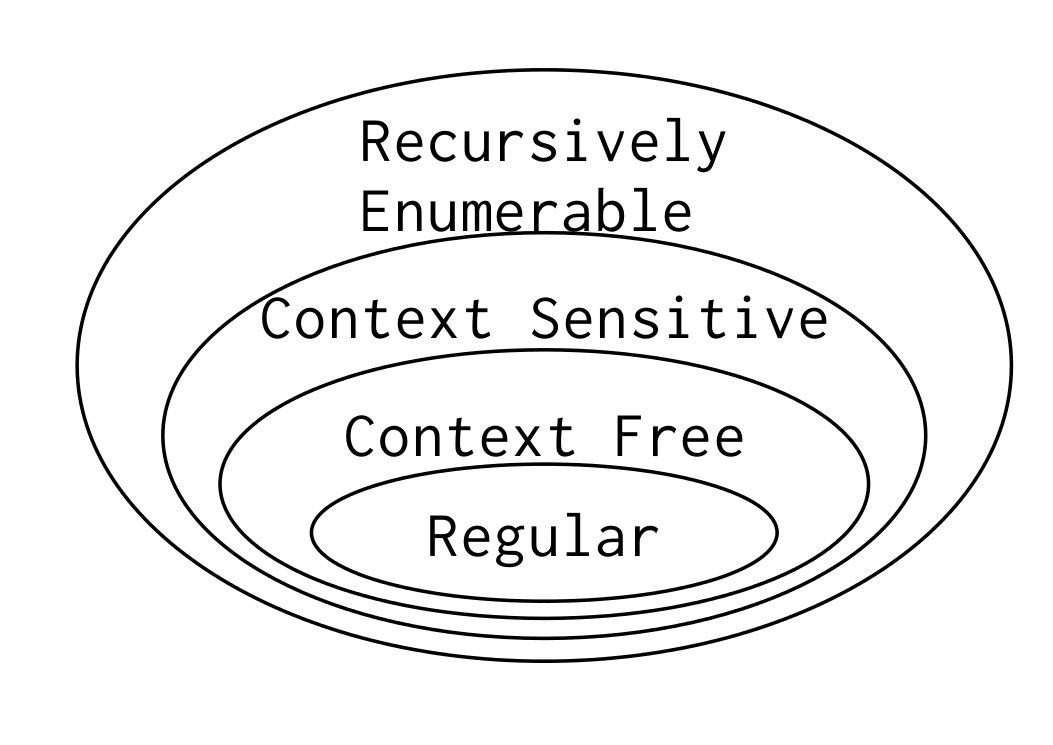
Regular
Boring and Safe
No matching parens
features: delimiters
source
Context Free
less boring, mostly safe
features: {(nesting)}
source
Context Sensitive
less boring, mostly safe
features: field length prefixes allowed

source
Recursively Enumerable
can describe turing machine
most powerful

source
Chomsky Hierarchy
Chapter 1.a: Formal Language Recognition
Decidability of formal language recognition
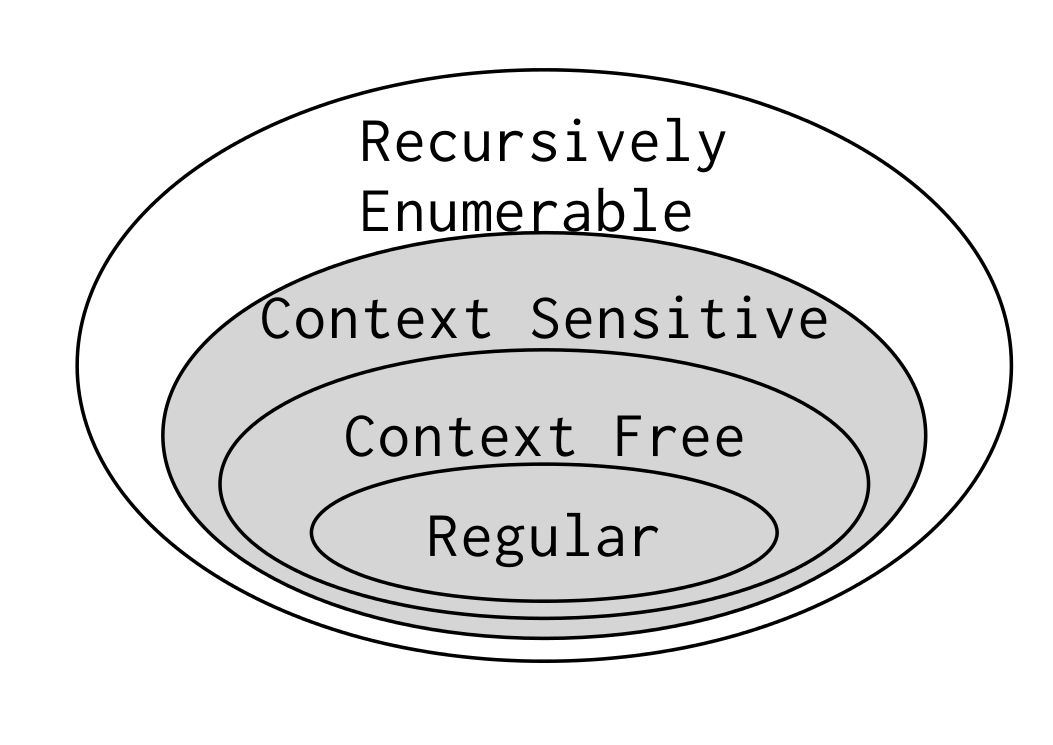
Recursively Enumerable
can describe turing machine
most powerful
Goose has root
source
Context Sensitive
or below
Decidable
source
Chapter 1.b: Comparing Formal Language Parsers
Context Free has two parts
Deterministic
Non-Deterministic
deterministic context-free
comparing parser equivalency:
decidable
source
Woah
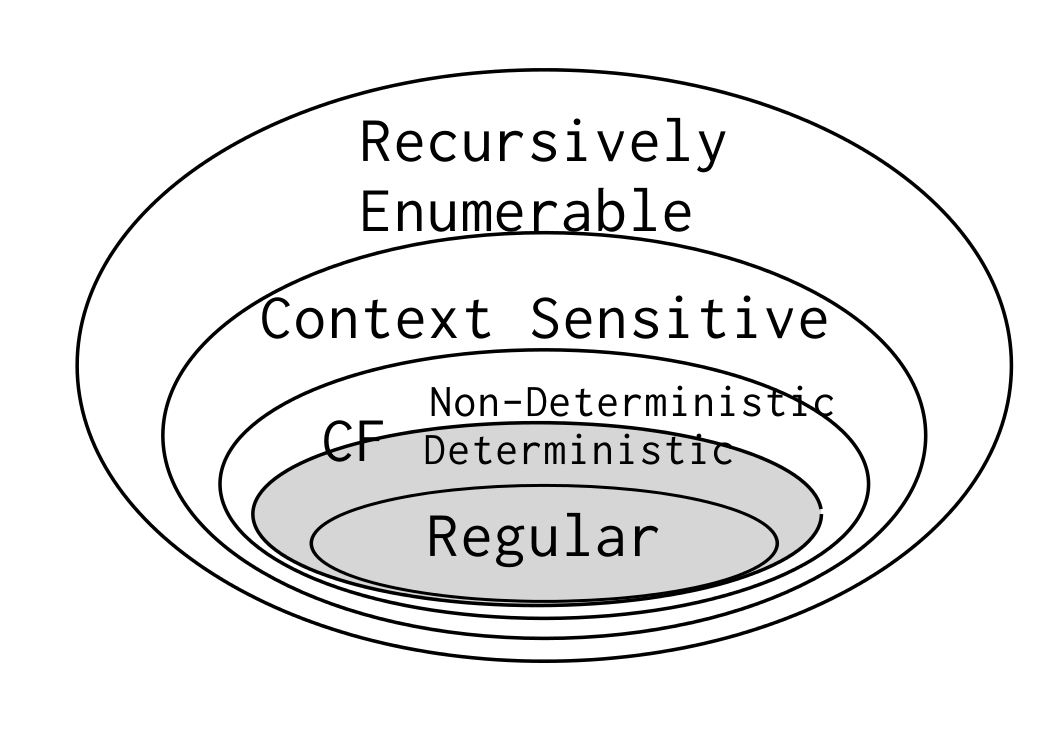
recognize inputs completely before processing them
use deterministic context-free languages (or less) as inputs
LangSec no noes
- Turing Complete Inputs
- ad hoc input validation
- weak parsers checking strong languages
Turing Complete Inputs
"This system is very extendable/updatable because it embeds macros/scripting/programming language in data" --run like hell
-- Science of Insecurity
ad hoc input validation
AKA Shotgun parsing
weak parsers
checking
strong languages
1 2 3 | if in_xml =~ /valid-codes/ fire_z_missiles(in_xml) end |
TL;DR Use JSON
WRT Rails
parsing too early, too generally
        |  IN      |
  Rails |[parse   ]|
        |          |
  ------+----------+
  App   |[validate]|
        |[ use    ]|
        |  IN      |
  Rails |          |
  ------+----------+
  App   |[parse   ]|
        |[validate]|
        |[ use    ]|
Goal:
rm -rf undefined_behavior
don't allow undefined inputs!
↶
Only allow defined inputs!
Patched Postel Principle
1 2 3 4 5 6 7 8 9 10 11 12 13 14 15 16 17 18 19 20 21 22 23 24 25 26 27 28 29 | The Postel Principle Patch: --- ietf/postels-principle +++ ietf/postels-principle - Be liberal about what you accept. + Be definite about what you accept.(*) + + Treat inputs as a language, accept it with a matching computational + power, generate its recognizer from its grammar. + + Treat input-handling computational power as privilege, and reduce it + whenever possible. + + + (*) For the sake of your users, be definite about what you accept. + Being liberal worked best for simpler protocols and languages, + and is in fact limited to such languages; be sure to keep your + language regular or at most context free (no length fields). + Being more liberal did not work so well for early IPv4 stacks: + they were initially vulnerable to weak packet parser attacks, and + ended up eliminating many options and features from normal use. + Furthermore, presence of these options in traffic came to be regarded + as a sign of suspicious or malicious activities, to be mitigated by + traffic normalization or outright rejection. At current protocol + complexities, being liberal actually means exposing the users of your + software to intractable or malicious computations. |
Be definite about what you accept.(*)
Treat inputs as a language, accept it with a matching computational power, generate its recognizer from its grammar.
Treat input-handling computational power as privilege, and reduce it whenever possible.
Defining inputs...
Isn't that a pain?
Yes! yes it is!
But, we already do!
Rails input validation
Rails 3 attr_accessible
Rails 3 attr_accessible
1 2 3 | attr_accessible :name attr_accessible :name, :credit_rating, :as => :admin |
pluses
all access controlled
blows up on bad keys
minuses
definition / usage in different locations
different use case handling
Rails input validation
Rails 3 attr_accessible
Rails 4 Strong Parameters
Rails 4 Strong Parameters
1 2 3 4 | params.require(:person). permit(:name, :age, pets_attributes: [ :name, :category ]) |
Pluses
definition / usage in same location
schema allows for nesting
minuses
silently strips unpermitted keys
Schema is ambiguous
Why not earlier?

Muskox is a schema based Parser Generator
Give it a JSON Schema definition
1 2 3 4 5 6 7 | extend Muskox::Extensions add_parser :user, type: :object, properties: { name: { type: :string }, email: { type: :string } } |
And it will only allow valid strings to be parsed
1 2 3 4 | MyParsers.parsers[:user]. parse( %!{"name":"me", "email":"x@y.com"}!) # => {"name"=>"me", "email"=>"x@y.com"} |
1 2 3 4 5 | MyParsers.parsers[:user].parse( %!{"hash_dos1":1, "hash_dos2":1, "hash_dos3":1}!) # Muskox::ParserError: # Unexpected property: [hash_dos1] at root. # Allowed properties: [name, email] |
Structure
Break Parser in Two
tokenizer
recognizes language (JSON)
passes tokens to validator
validator
validates against provided schema
uses tokens to create Ruby objects
MuskOx w/ Rails
Replace strong params
1 2 3 4 | def login_params params.require(:user). permit(:login, :password) end |
Replace Strong Params
1 2 3 4 | muskox_params :user_params do |m| m.require(:user). permit(:login, :password) end |
Muskox Future
new tokenizer formats: XML, Form encoded data, ...
References
langsec.org
github.com/baroquebobcat/muskox
Nick Howard
@baroquebobcat


photo (mod w/ sombrero)